Framework: Operational Phase
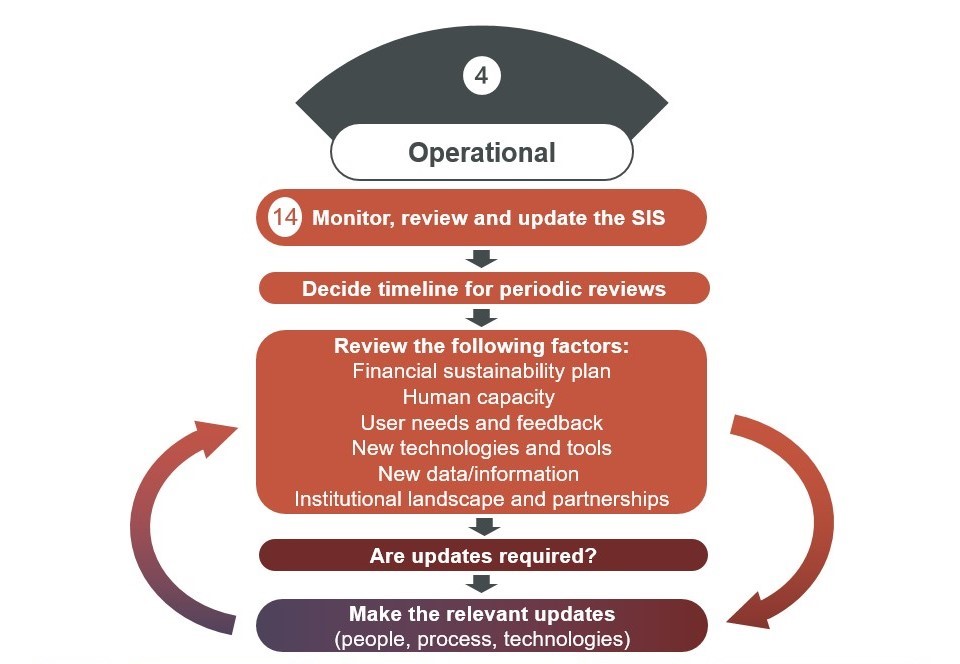
This phase focuses on supporting the national owner in the long-term operation and maintenance of the system. It involves regular reviews of the enabling environment and continuous engagement with users to enhance and scale the system. To ensure comprehensive feedback, these reviews should include a diverse group of stakeholders, fostering their ongoing involvement. Once the review is complete and updates have been identified, it may be necessary to revisit earlier phases and components for adjustments. The operational SIS is not static; it should be viewed as a dynamic system in continuous development.

Objective:
Keep the SIS functional, updated and relevant so that it continues to provide impact to its users. It is not just about keeping the SIS operational, but considering what changes are needed to ensure continuous growth and scalability- you can go back to any previous phase and re-do relevant components.Activities:
-
Conduct periodic reviews
-
Which activities do you want to review/conduct again throughout the lifespan of the
SIS? We recommend revisiting the following components:
- Envisioning
- Enabling environment assessment
- Needs assessment
- Data strategy
- Organisational plan
- Financial sustainability plan
-
How often will you conduct these reviews—annually, biannually, or every two years?
- For example, you could hold annual reviews with the internal SIS team and organize broader stakeholder sessions every two years. These sessions will evaluate whether the SIS continues to meet user needs and identify any necessary updates or changes. Additionally, these engagements will raise awareness of the SIS and strengthen stakeholder participation. If a SIS is not relevant for end-users, they won't use it anymore.
- Do you have the budget and resources required for these periodic reviews?
- Who should be responsible for each review and incorporating the necessary updates to the SIS?
-
Which activities do you want to review/conduct again throughout the lifespan of the
SIS? We recommend revisiting the following components:
-
Monitor the System
- How often will you monitor the effectiveness of the SIS? E.g. every 3 or 6 months?
- What will you monitor- usage and availability statistics?
- How will you conduct performance monitoring and user satisfaction reporting?
- Is the SIS receiving continuous feedback from users for improvement? How is this being assessed, prioritized and addressed?
- For any technical updates to the system, follow the guidance in component 11, 12 and 13.
-
Update and improve the SIS
- Is the SIS regularly receiving new data? E.g. from a soil monitoring program, R&D and development community projects or the private sector.
- Is there a team available to collect new soil data to regularly update the system?
- Are there any new changes or activities impacting the soil? Do you need to update the soil data in the SIS? e.g. anthropogenic activities affecting the soil.
- Based on the findings of the periodic reviews conducted, what updates or actions are required?
- How is the SIS addressing the use cases?
- Have any new risks emerged and how will they be managed?
- Are there new technologies that can improve the SIS?
- Is there scope and budget for the addition of decision support tools and apps?
- If you are making updates to the system, have you followed the iterative testing cycle as per the implementation phase?
-
Supporting
resources
- Review the example of Australia's national soil monitioring program
- Review how EUSO conducts regular soil monitoring
- Review the recorded EUSO meeting of 21-23 October 2024 on the soil monitoring programme in France
- Review the example of the French national soil monitoring scheme (RMQS) and the French Soil Quality Monitoring Network Manual.